
Checking is the finish breaking, not the wood
Checking looks like a spider web or a set of thin parallel lines in the finish. It sits in the lacquer only. The wood underneath is usually fine.
It shows up most on nitro, the thin lacquer on many older guitars and some new ones. Nitro gets hard and brittle with age, and it gets more brittle when cold. Poly, the thicker plastic coat on most modern guitars, is far less likely to check.
A checked finish does not change the tone or the playability. It is a cosmetic scar. Some players like the look. Most would rather not add to it.
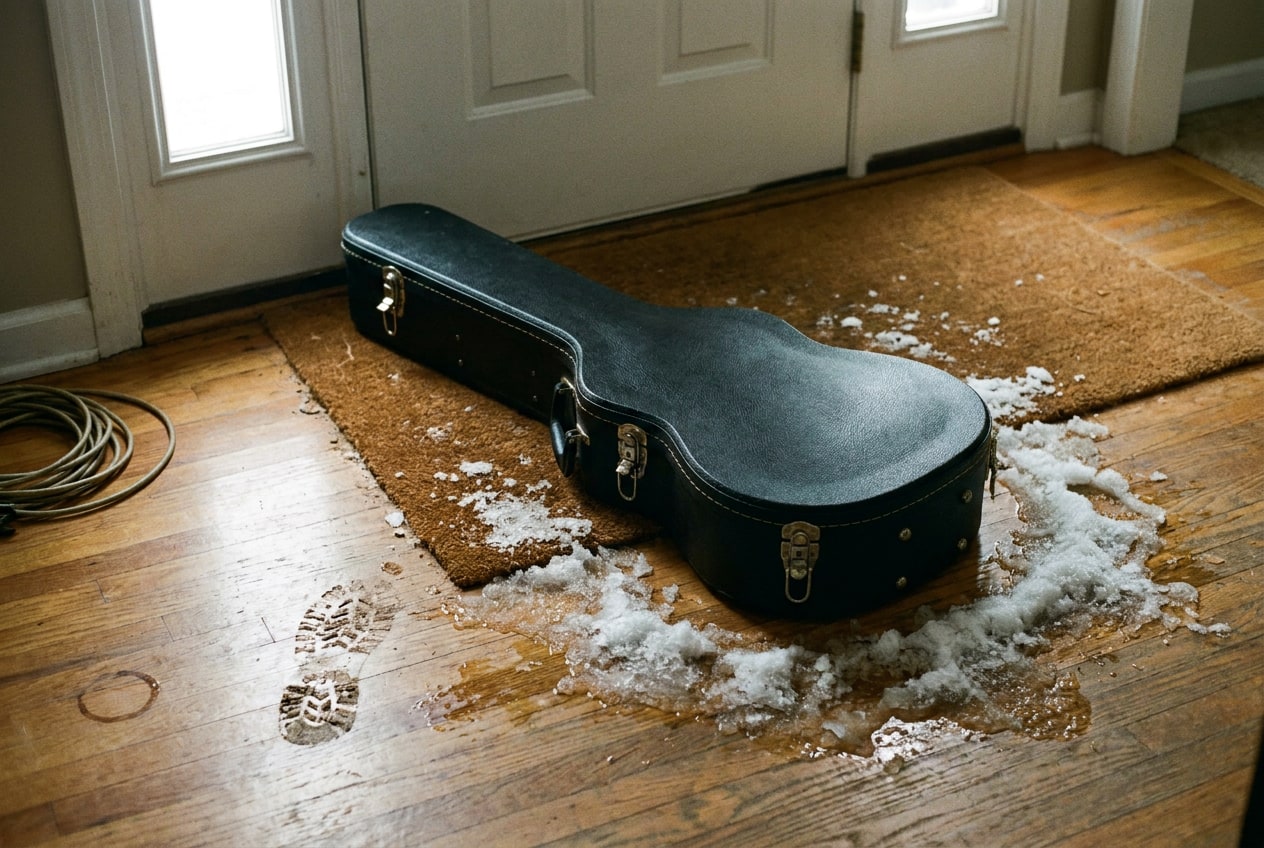
Fast change does the damage, not cold itself
Wood and lacquer grow and shrink with temperature, but not at the same speed. The lacquer shrinks and stiffens in the cold.
When the guitar warms quickly, the wood swells faster than the stiff lacquer can follow. The lacquer gives way and cracks.
A guitar can sit in a cold car for hours without checking. The trouble starts when you carry it from that car into a warm house and open the case right away. The warm air hits a cold, brittle finish, and the lines appear in minutes.
The same thing can happen in reverse on a smaller scale. A hot guitar taken into air conditioning is under stress too. Any fast swing is the risk.
Leave it in the case until it is room temperature
The fix is patience. The closed case slows the warm-up so the wood and the lacquer can move together.
Here is what to do with any guitar that comes in from the cold:
- Bring the case inside and set it on the floor, away from any heat vent, radiator or fireplace.
- Leave the latches closed. Do not peek.
- Wait a few hours. An overnight wait is better if the guitar has been very cold.
- Touch the outside of the case. If it still feels cold, keep waiting.
- Open the lid a crack for a while before lifting the guitar out.
- Check the tuning last. Strings go sharp when cold and settle as the neck warms.
Never leave a guitar in a car in either season
A car is the fastest way to get a big temperature swing. In January the trunk drops to outdoor cold within an hour. In July a closed car gets hotter than any room in your house.
Heat does a different kind of harm. Nitro softens when hot. A soft finish can take a print from the case lining, and a pick left on the top can leave a mark.
Glue joints also soften in heat. That is bad news for the bridge on an acoustic.
If the guitar has to ride along, keep it in the cabin, not the trunk. Carry it in with you at every stop. Treat it the way you would treat a dog in the car.
Hang it where the temperature stays steady
Most checking happens on the road, but a wall can do it too. A spot above a baseboard heater or beside a forced-air vent swings warm and cold all winter long.
An outside wall gets cold at night and warms by day. A sunny window bakes the finish each afternoon.
The best spot is an inside wall, away from vents, windows and doors to the outside. That spot keeps the temperature close to steady. It also keeps the air near the wood closer to the safe zone of 45 to 55 percent humidity.
Below 40 percent the wood dries and shrinks. Above 60 percent it swells. Both put extra stress on a finish that is already working hard.
The wall matters more than the room. A hygrometer, the small gauge that reads humidity, tells you about the shelf it sits on, not the wall across the room.
A mount with the hygrometer built in, like HygroMount, puts the number at the headstock where the guitar hangs. If you are not sure how your own wall behaves, the free room check at stringhands.co/check/ gives a quick estimate from your local weather.
- Pick an inside wall.
- Stay several feet from any heat vent or radiator.
- Keep it out of direct sun through a window.
- Avoid the wall right beside an outside door.
If it already checked, leave it alone
Checking does not spread on its own and it does not need repair. Filling or sanding the lines usually looks worse than the lines did. Most repair techs will tell you to live with it.
What you can do is stop adding to it. Keep the guitar out of the car, give it a slow warm-up in the case, and hang it somewhere steady. The cracks you have are the only ones you will get.
Common questions
What causes finish checking on a guitar?
Fast temperature change. Cold makes the lacquer brittle, and a quick warm-up makes the wood swell faster than the finish can stretch, so it cracks in fine lines. Nitro lacquer checks far more easily than poly.
How long should a guitar warm up in the case?
A few hours at least, and overnight if it has been very cold. Keep the case closed and away from heat vents the whole time. Open it only when the outside of the case no longer feels cold.
Does finish checking hurt the guitar?
No. The cracks are in the lacquer, not the wood, and they do not affect tone or playability. It is a cosmetic mark that is best left alone.
Can a guitar check in a warm house?
Yes, if it hangs near a heat vent, a radiator or a sunny window. Those spots swing warm and cold every day. An inside wall away from vents and windows stays steady.