
The neck has been carrying a heavier load since the day it was strung
Tune a guitar to pitch and six strings pull on that neck constantly, trying to fold the headstock toward the bridge. A set of mediums on a dreadnought is a serious amount of pull. The guitar is designed around it, with a truss rod, a reinforced heel, and a joint glued or bolted to take exactly that stress for decades.
Now hang the same guitar from a wall hook. Gravity adds the weight of the body along the length of the neck, in a direction the whole structure is already braced to resist, and it is a fraction of what the strings are doing.
Repair shops have hung guitars by the headstock on pegboard for as long as there have been repair shops, including the valuable ones waiting for a neck reset. Set neck, bolt-on, classical, bass, twelve-string. We have had all of them on walls for years and have never seen a joint move because of the hook.
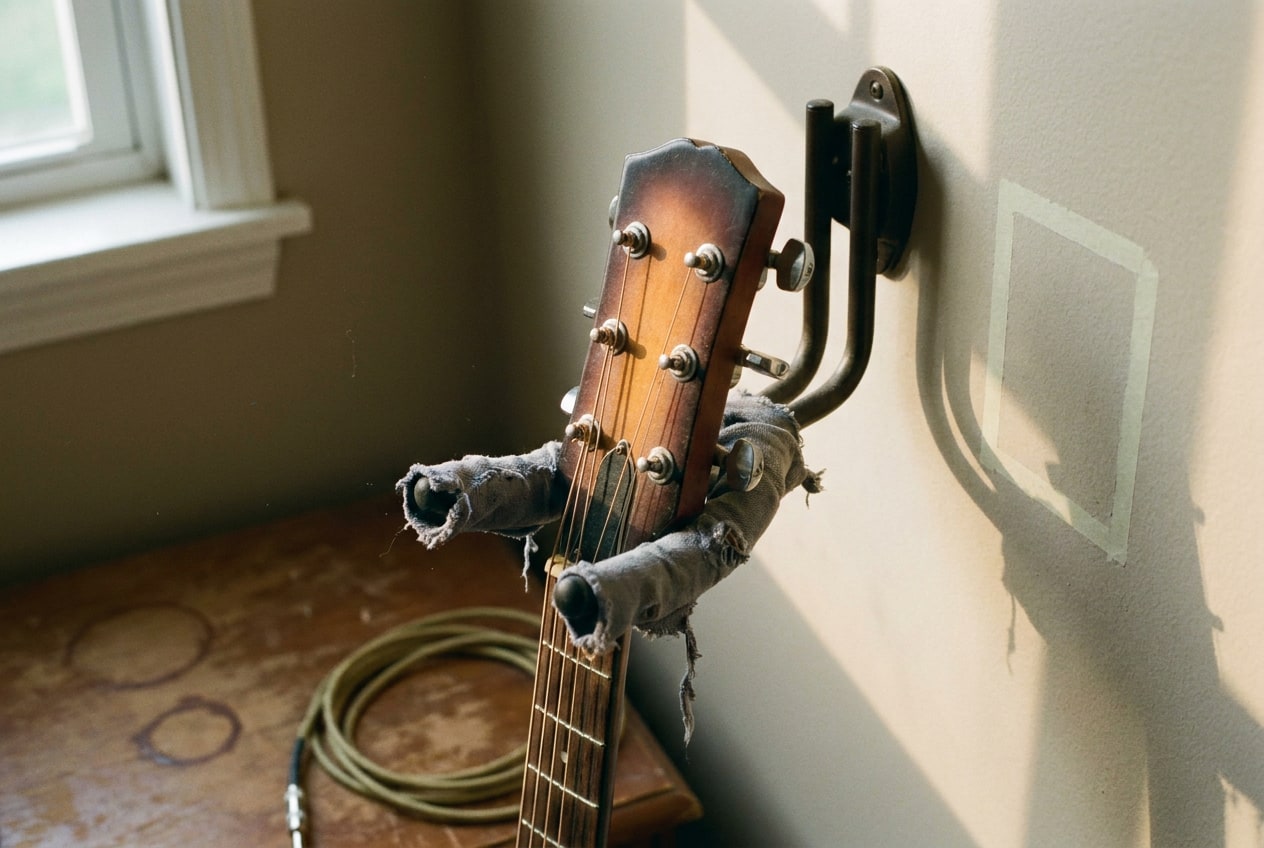
What actually marks a neck is the yoke, and only on some finishes
The real complaint behind this question is usually a mark, a dull patch or a soft spot on the back of the headstock where it sat in the hanger. That is a chemistry problem. Nitrocellulose lacquer, the finish on most Gibsons, Martins, higher-end Fenders and anything vintage, stays slightly reactive for its whole life. Press certain rubbers and vinyls against it for weeks and the plasticizers in the rubber migrate into the lacquer. The finish clouds, softens, and in bad cases takes the texture of whatever was touching it.
Polyurethane and polyester finishes, which cover most imported and mid-priced guitars, are far more inert. We have never seen a poly neck marked by a hanger.
Wrap the yoke arms in plain cotton, a strip from a worn T-shirt, a baby sock, or self-fusing silicone tape, which does not react with nitro. Check the back of the headstock after the first week and again after a month. If nothing has changed, it will not change. A hanger labeled safe for nitro still gets checked. Formulas vary and a label is not a test.
Hanger contact can burnish a satin neck to gloss in a spot the size of a thumb. It is cosmetic, harmless, and permanent, so if the matte look matters to you, pad the yoke.
Angle, yoke width, and which way the strings face
A hanger holds the guitar at the nut, the narrowest place on the neck and right where the headstock widens to stop it sliding through. Nearly every guitar hangs strings out, with the back of the headstock resting in the yoke, which puts the load where the wood is thickest.
A classical or a wide-nut acoustic in a yoke made for a Stratocaster will sit on the arms instead of between them, and now the hanger is pressing on the edge of the fretboard or on the first fret. Measure the neck at the nut and pick a yoke that clears it with a little room. A yoke that is too wide is fine. The guitar settles to the center.
Headstock angle changes how the guitar leans. A Gibson style tilt-back headstock sits deeper and tends to hang straight, while a Fender style flat headstock makes the body kick out from the wall a bit. If the lower bout is resting against the drywall, raise the hanger or add a felt pad behind it so the finish is not rubbing every time someone walks past.
Leave the tuners alone. The yoke sits above or between the tuning posts, against wood, so no weight bears on them.
Strap-button hangers and the other ways to get it off the floor
Strap-button hangers hold the guitar by the end pin or the upper strap button instead of the neck. They exist mostly for people who do not trust neck hangers, and for guitars whose headstocks will not sit in a yoke, like some headless designs or an odd shaped vintage piece. The strap button is a screw into the end block, which is plenty strong, and the guitar hangs straight down in a position it already knows from every gig.
Two drawbacks. The whole weight of the guitar bounces on that one screw every time it is taken down and rehung, and on an acoustic with a plastic end pin the pin is doing the work, so check that it is a screwed-in button and not a tapered friction pin before trusting it. The guitar is also harder to grab and harder to put back, so it gets played less.
Horizontal mounts, where the guitar lies along the wall like a painting, look wonderful and spread the load across the body and neck. They take up a lot of wall and cost more. For one guitar you love in a living room, they are worth it. For a wall of six electrics they are not practical.
Floor stands are what most people start with, and they are what most cracked headstocks we have seen started with. A stand gets kicked, bumped by a vacuum, or knocked by a dog. A guitar on a wall hook at eye level is out of traffic. We would rather see a neck in a padded yoke than a guitar standing in the path of a chair leg.
The wall does more damage than the hanger ever will
A hanger never cracked a top. Dry air does it every winter, and the wall is the driest place in the room.
An exterior wall runs colder than the center of the room, and cold surfaces dry the air next to them. Hang a guitar above a forced-air register and it gets a blast of freshly heated, bone dry air every time the furnace cycles. Hang it where afternoon sun falls across it and the finish heats up, the glue softens, and the wood dries out faster than the room around it. Solid wood wants 45 to 55 percent relative humidity. Below 40 the top starts shrinking across the grain and the frets start poking out of the fretboard. Above 60 the top swells, the action rises, and the bridge starts thinking about letting go.
The hygrometer on the desk across the room will tell you none of this, because it is measuring the calm air at the desk. We have measured a wall reading more than ten points drier than the desk in the same room on the same afternoon.
Pick an interior wall, away from vents and windows and anything that radiates heat. If the only wall available is an exterior one, hang the guitar there anyway and watch the number closely. The free room check at stringhands.co/check/ will give you a rough idea of what that wall is likely doing from your local weather before you drill anything.
How we hang our own
Every guitar in the shop hangs by the neck and has for years.
A mount with the hygrometer built in, like our HygroMount, puts the reading inches from the headstock, which is the only place the number has ever mattered. A separate hygrometer on a shelf works fine too as long as you move it to the wall and leave it there. The hanger is the easy part. The air is what you are managing.
- Find a stud. A neck hanger in drywall anchors alone is the one way a hanger really can hurt a guitar.
- Interior wall if there is one, away from registers, radiators, windows and direct sun.
- Pad the yoke for any nitro or satin neck, then look at the back of the headstock after a week.
- Measure the nut width before buying a yoke.
- Put a hygrometer at the wall, at headstock height, and read it every few days through the first winter and the first humid stretch of summer.
- Case the guitar with a humidifier if the wall reading sits under 40 percent for more than a few days, and hang it again when the room comes back.
Common questions
Can hanging a guitar by the neck warp it?
No. The strings pull on the neck far harder than its own weight ever will, and the neck is built to take that pull indefinitely. Warped necks come from humidity swings and heat, which a wall can deliver, but the hook itself has nothing to do with it.
Will a wall hanger damage a nitrocellulose finish?
It can, if the yoke padding is a rubber or vinyl that reacts with the lacquer. Wrap the arms in cotton or self-fusing silicone tape and check the back of the headstock after a week. Poly finishes almost never mark.
Is it better to hang a guitar or keep it in the case?
For the wood, a case with a humidifier is the safest place in a dry winter or a muggy summer. For actually playing it, the wall wins every time. We hang ours and case them only when the reading at the wall drifts below 40 or above 60 percent for more than a few days.
Should I loosen the strings before hanging a guitar long term?
Leave them at pitch. The guitar was built to live under full tension, and slacking the strings changes how the neck relaxes and makes the setup drift. If it is going on a wall for a season, keep it tuned and keep an eye on the humidity instead.