
The fret ends go first
The first sign lives under your thumb. Slide it slowly along the bass side of the neck from the nut down toward the body. On a guitar that was happy in October the frets end flush with the wood and you feel nothing. On a guitar that has hung in dry air for a couple of weeks you feel a tiny ridge at each fret, like a row of stitches. Players call it fret sprout.
The metal didn't grow.
The rosewood or ebony under it shrank across its width, and the frets are now wider than the board that holds them. It takes a real amount of moisture loss for that to happen, which is why sprout is such a dependable early warning. By the time you can feel it, the rest of the guitar is losing water too.
Check the treble side as well. It's usually the same story on both edges, but a neck that only sprouts on one side is often telling you which way the guitar faces a vent or a window.
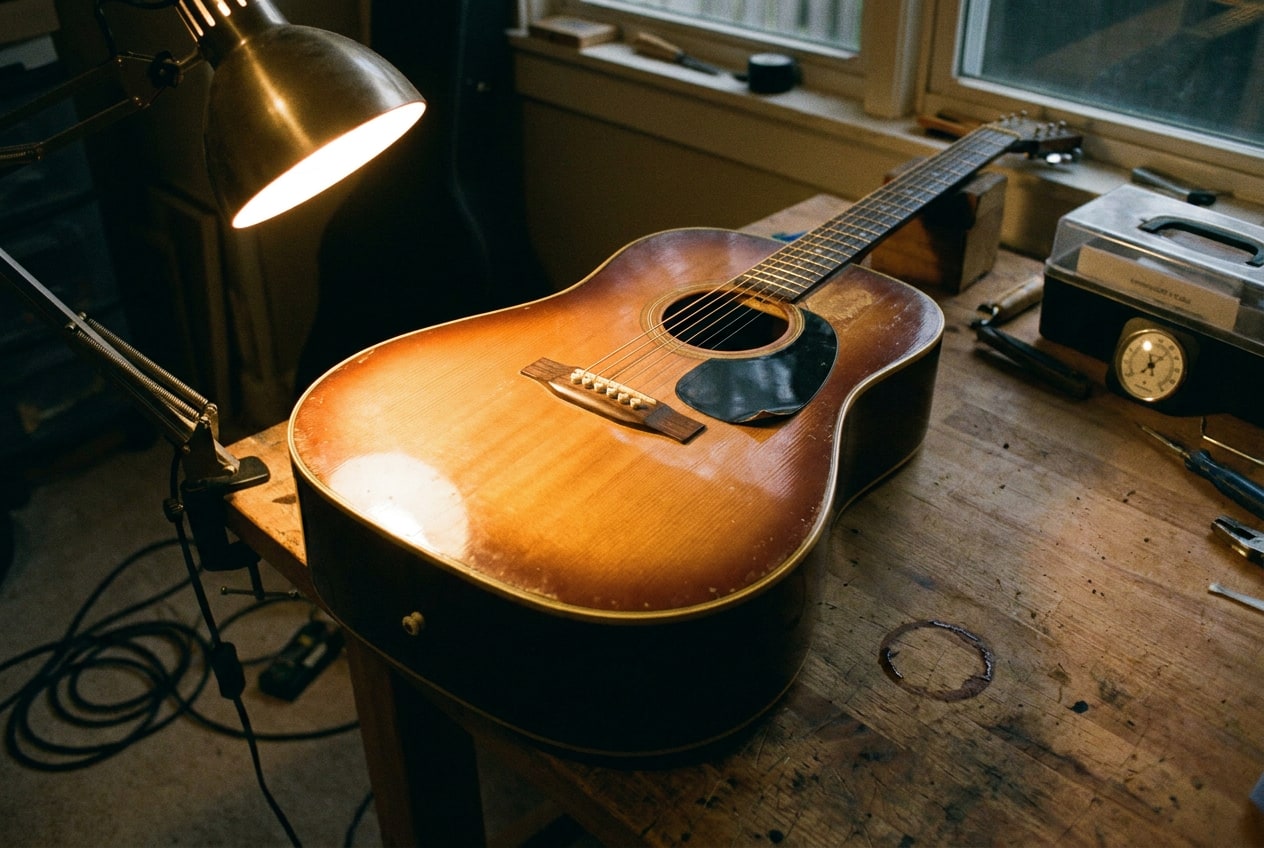
The action drops and the buzz shows up low on the neck
There's a change you might welcome for about a day. The action gets lower. Chords feel easy. Then the low E buzzes on an open G, then the D string on the third fret, and now you're reaching for the truss rod wrench.
Put it down.
On an acoustic the top is a shallow arch, held up by bracing and string tension in balance. When the spruce or cedar dries it shrinks across the grain, the arch flattens, and the bridge sinks with it. The saddle comes down and the strings come down with it. A tenth of a turn on the truss rod will chase the symptom for a week, and when the humidity comes back in April you'll own a neck adjusted for a guitar that no longer exists.
Lay a straightedge across the top behind the bridge, or just sight down the top against a window. A healthy top shows a gentle rise. A dry one goes flat. A badly dry one dishes in behind the bridge, and you can see the bridge tilting forward with the string pull.
Look at the finish under a low light
Hold the guitar so a lamp skims across the top at a shallow angle. On a guitar sitting in the safe zone, 45 to 55 percent, the finish looks like glass laid over wood. On a dry guitar you see the grain telegraphing through: fine ridges and valleys running with the grain lines, because the hard and soft growth in the spruce shrink at different rates and the lacquer follows them down.
That texture isn't damage yet, just the wood showing you how far it has already moved. Gloss shows it first, satin hides it longer, and old nitro shows it far more than poly ever will.
While the light is out, look at the edge of the pickguard. The top shrinks and the plastic doesn't, so the first thing you see is a hairline of bare wood along the pickguard's edge or a lifted corner. That is the exact spot where the first crack tends to start on a dreadnought.
The small parts start to let go
After the top has moved, every joint where two different materials meet starts to complain. A two minute walk around the guitar every couple of weeks in heating season catches most of it.
On electrics the body is thick enough to shrug most of this off, but the neck is the same slab of maple or mahogany that's on the acoustic, and it moves the same way. A Strat that suddenly needs the saddles raised in January is telling you the same story a dreadnought tells with its bridge.
- Binding pulling away from the body at the waist or the cutaway, or a seam you can catch a fingernail in.
- Bridge pins that sit proud, or a bridge whose back edge you can slide a slip of paper under.
- The saddle leaning forward in its slot because the bridge has tilted with the top.
- Braces you can hear. Rap the top gently near the lower bout; a loose brace gives a dull rattle instead of a clean knock.
- Sharp binding on the fretboard edge, which is just fret sprout's quieter cousin.
What the first crack actually looks like
Most owners picture a dramatic split. The real thing is a hairline you'd mistake for a grain line, and it runs with the grain because that's the direction the wood has the least strength once it has shrunk. It shows up beside the pickguard, along the centre seam below the bridge, or down from the fretboard extension where the neck block holds the top still while everything around it moves.
Run a fingernail across it. A grain line is smooth. A crack catches. Shine a flashlight inside through the soundhole with the room dark and any real crack shows as a thin line of light on the top.
Every stage before this one comes back on its own when the wood takes on water again. A crack doesn't.
Trust the wood over the meter on the desk
All of this happens below 40 percent, and a guitar can be sitting there while the hygrometer on the bookshelf across the room says 47. The air at an exterior wall is drier and colder than the air in the middle of the room, and the wood answers to the air touching it, nothing else.
So use the guitar as the instrument for a while. Thumb the fret ends when you take it down. Sight the top against the window. If you'd rather see a number than guess, put a hygrometer where the guitar actually hangs. HygroMount is a wall hanger with the readout built in at the headstock, reading to within about two points, with no app or Wi-Fi to fight. A number at the headstock means something. A number across the room mostly means the desk is fine.
If you don't own a hygrometer at all, the free room check at stringhands.co/check/ will give you a rough estimate of what the air at your wall is doing from your local weather. It is a starting guess, and you should still touch the neck.
Once you've caught it early
Take the guitar off the wall and put it in its case with a soundhole or case humidifier for a week or two. Leave the truss rod alone. When the fret ends go flush again and the top rises, you'll know the wood has recovered, and you'll know your setup was never the problem.
Then fix the room, because the guitar will go right back to drying the day you hang it again.
A room humidifier near the wall where the guitars live does more than one in the hallway. Fill it every night through the coldest weeks. Check the fret ends again in ten days.
Common questions
How dry is too dry for a guitar?
Solid wood wants 45 to 55 percent relative humidity. Below 40 the fret ends start to sprout and the top begins to flatten, and the longer it sits there the closer it gets to a crack. Measure at the guitar, where the wood actually hangs.
Will a dry guitar fix itself when humidity comes back?
Most of it will. Fret sprout eases, the top rises, the action comes back up and the pickguard edge closes. Cracks and loose braces don't reverse, and a top that was adjusted with the truss rod while dry will need adjusting again.
Can an electric guitar get too dry?
Yes, mostly in the neck. The fretboard shrinks and sprouts frets exactly like an acoustic, and the relief changes with it. The solid body is thick enough that you rarely see it move, but a bound fretboard or a set neck joint can still open up in a hard winter.
Should you loosen the strings on a dry guitar?
Not as a first move. The string tension is part of what holds the top's arch, and the fix is water. Get it in the case with a humidifier and let the wood come back before you touch anything else.