
Basements swing further than upstairs rooms
A basement sits against cool concrete and dirt. In summer, warm damp air comes down the stairs and meets those cool walls. The moisture in that air has nowhere to go, so the room stays wet.
In winter the same room flips. The furnace often lives down there, and forced-air heat dries the air fast. The basement that felt like a cave in July can sit below 40 percent by January.
Solid wood guitars track that swing. Above 60 percent the top swells and the action (the string height) climbs. Below 40 percent the top shrinks, the fret ends poke out, and cracks start along the grain.
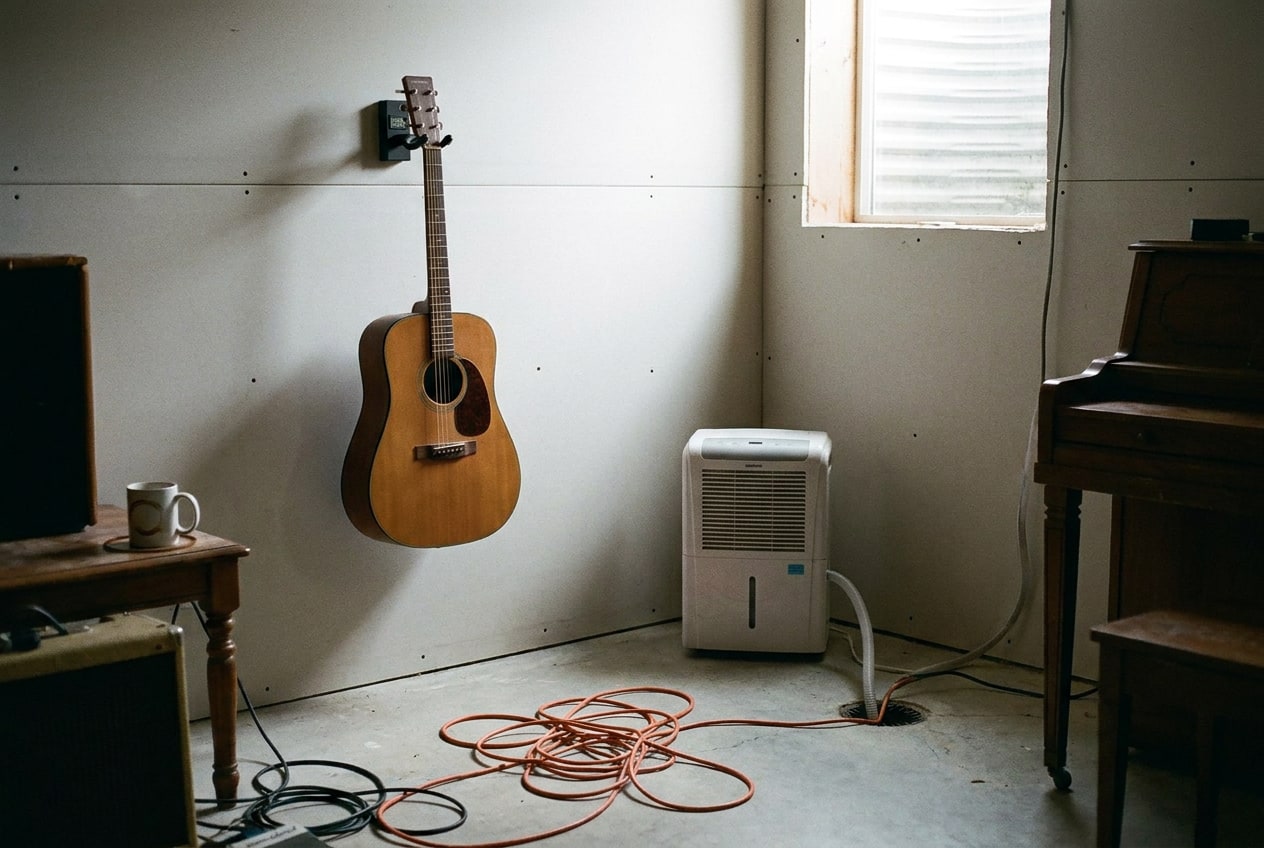
Summer in a basement music room is the damp problem
Damp is the basement's famous side, and it earns the name. The signs are slow.
Strings rust faster. The top bellies up behind the bridge. The neck feels stiff and the action creeps high.
The fix is a dehumidifier running on its own setting, not on full blast. Set it near 50 percent and let it cycle. Most will say on the box what size room they handle. Pick one made for the room you have, not the smallest one in the aisle.
A hose to a floor drain beats emptying a bucket. A full bucket shuts the machine off, and a basement can climb above 60 percent in a wet weekend.
- Set the dehumidifier to hold about 50 percent, not its lowest setting.
- Run the drain hose to a floor drain or sump pit so it never stops on a full tank.
- Keep it a few feet from the guitars. The warm exhaust air right beside it reads dry.
- Close the basement windows in humid weather. Outside air in July adds water, not relief.
Winter in a basement music room is the dry problem
The furnace is usually in the basement, with the ducts running overhead. That makes the basement the first room to dry out when the heat kicks on.
Dry wood warns you before it splits. Fret ends feel sharp along the neck.
The top sinks flat or dips below the bridge. A buzz shows up on strings that played clean in October.
Unplug the dehumidifier for the season. Then run a humidifier in the room, set to hold between 45 and 55 percent. Place it on the far side of the room from the guitars, so mist never lands on a finish.
- Switch off and empty the dehumidifier when the furnace starts running daily.
- Run a room humidifier and aim for 45 to 55 percent at the guitars.
- Keep guitars out of the stream of any heat vent or the furnace room door.
- Case the most valuable acoustic with a case humidifier if the room drops below 40 percent.
Pick an inside framed wall, not the concrete
Where you hang in a basement matters more than how you hang. An outside concrete or block wall stays cold and sweats in summer. The air right against it is wetter than the middle of the room, and colder in winter.
We would hang on a framed inside wall, away from the furnace room and any vent. Finished drywall over studs is ideal. Hang into the stud, as with any wall.
- Choose a framed inside wall, not a foundation wall.
- Stay clear of heat vents, the furnace door, and the dehumidifier exhaust.
- Skip the wall beside the washer and dryer. That corner runs wet and warm.
- Avoid the spot under a window well, where seep and cold both show up first.
Measure at the guitar, not across the room
A basement is not one climate. The corner by the concrete, the spot under the duct, and the middle of the room can all read differently on the same afternoon. The number that matters is the one at the headstock.
A hygrometer is a small gauge that reads relative humidity, the amount of water in the air. Put one at the wall where the guitars hang. A mount with the hygrometer built in, like HygroMount, puts that number inches from the headstock, with no app and no Wi-Fi to fuss with.
If you have no gauge yet, try our free room check at stringhands.co/check/. It estimates what a wall in your area is doing from the local weather. It is a starting point, not a replacement for a gauge on the wall.
A basement check that takes one minute
Basements change with the seasons, so a short habit catches the swing before the wood does. We would do this on the first of the month and after any big weather change.
- Read the humidity at the guitar wall. Anything from 45 to 55 percent is good.
- Below 40 percent: start the humidifier and sight down the neck for a dipped top or sharp frets.
- Above 60 percent: confirm the dehumidifier is running and draining, and check strings for rust.
- Touch the foundation wall. If it feels damp or cold, keep the guitars far from it.
- Note the reading. The seasonal pattern repeats, and next year you will see it coming.
Common questions
Is a basement a good place to keep guitars?
Yes, if you hold the air between 45 and 55 percent. A basement swings more than upstairs, damp in summer and dry in winter. A dehumidifier, a humidifier, and a gauge at the guitars make it a steady room.
What humidity should a basement music room be?
Aim for 45 to 55 percent at the guitars. Below 40 percent wood shrinks and cracks, and above 60 percent it swells and strings rust. Set your dehumidifier or humidifier to hold near 50 percent.
Does a basement music room need a dehumidifier?
In summer, almost always. Basements trap damp air against cool walls and climb past 60 percent. Run it with a drain hose, set near 50 percent, and shut it off when the furnace season starts.
Can you hang a guitar on a basement concrete wall?
We would not. A foundation wall stays cold, sweats in summer, and the air against it is wetter and colder than the room. Hang on a framed inside wall into a stud instead.