
Both guitars want 45 to 55 percent
Wood is wood. Spruce, mahogany, maple and rosewood all take in moisture from the air and give it back. When they do, they change size.
That is true on a dreadnought and on a Telecaster. So the safe zone is the same for both: 45 to 55 percent relative humidity, the number a humidity gauge shows.
Trouble starts below 40 and above 60. The guitars do not want different air. They just react to bad air at different speeds.
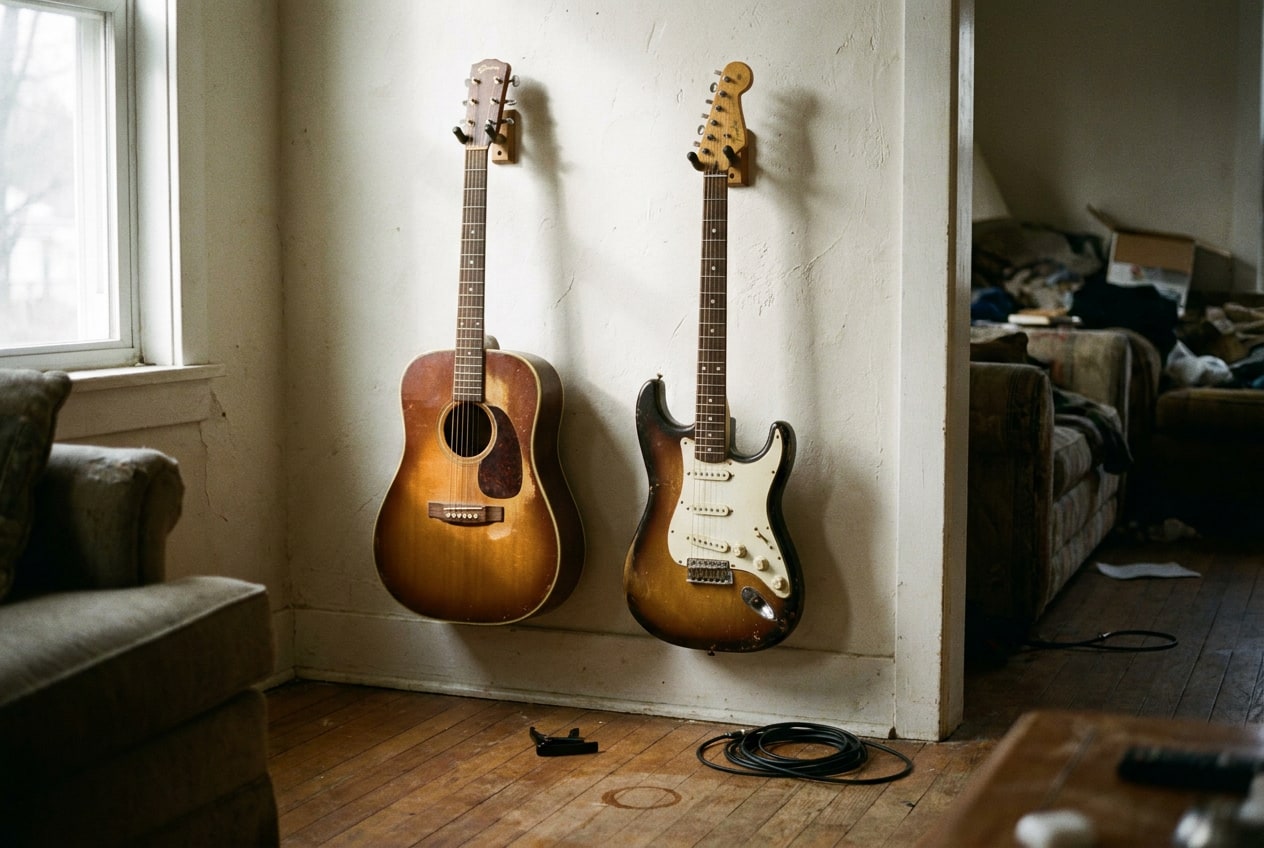
The acoustic top is thin, so it suffers first
A solid top acoustic has a top about as thick as a few business cards. It is glued at the edges, glued to braces underneath, and glued to a bridge that the strings pull on all day. It cannot move without something fighting it.
When the air drops below 40 percent, that top shrinks across the grain. It sinks, the action (the string height) drops, and strings start to buzz.
Keep going and the top cracks along the grain, often right beside the bridge or the fretboard. The bridge can also start to lift.
Above 60 percent the top does the opposite. It swells into a belly behind the bridge, the action climbs, and the sound goes dull. Glue joints soften in air that stays wet for weeks.
A laminate top, thin plies glued together, moves far less. It still has a solid neck and fretboard, so it is not immune. But a laminate acoustic behaves more like an electric than like a solid top.
The electric moves too, just slower
An electric body is a thick slab under a thick finish. It barely changes. That is why people think electrics do not care about humidity.
The body does not. The neck does. The neck is the acoustic top of an electric.
In dry winter air the fretboard shrinks across its width, and the metal frets do not. The fret ends poke out past the edge and feel sharp. The neck also loses a little relief, the slight forward curve it needs, so low strings buzz where they did not in October.
In wet summer air the fretboard swells, the neck bows forward, and the action creeps up. Hardware and strings rust faster too.
None of this cracks the guitar. All of it changes how it plays.
Semi hollow and hollow body electrics sit in the middle. Their tops are thinner and braced, so we treat them more like acoustics.
Check fret ends, action and the top twice a year
These signs show up first on each kind. Check them when the furnace comes on in fall and again when the basement turns damp in summer.
- Acoustic, too dry: a sunken top, low buzzy action, sharp fret ends, a gap under the bridge, a crack along the grain.
- Acoustic, too wet: a bellied top, high action, dull tone, a bridge that looks like it is tilting forward.
- Electric, too dry: sharp fret ends, new buzzing on open strings, a neck that needs a turn of the truss rod (the adjusting rod inside the neck).
- Electric, too wet: high action, a forward bow, rusty strings and screws, a sticky feeling neck.
Fix the room, not the guitar type
We would not buy a dry acoustic a humidifier and leave the electric to fend for itself. They share a room, so give the room good air. In winter that means a humidifier running where the guitars hang. In a humid basement it means a dehumidifier.
Hang both on an inside wall, away from heat vents, windows and outside doors. Then measure the air at that wall, not across the room. Air near a wall can read different from air at the thermostat.
Our free room check at stringhands.co/check/ will estimate the humidity at your wall from the local weather.
A mount with the humidity gauge built in puts the number right where the guitar hangs. HygroMount does that. The readout sits at the headstock and reads to within about two points, with no Wi-Fi, no app and no subscription.
One glance tells you if the acoustic needs help today. The electric gets the same good air for free.
Common questions
Do electric guitars need a humidifier?
Not a case humidifier, but they do need decent room air. Below 40 percent the fretboard shrinks and fret ends get sharp. Keep the room between 45 and 55 percent and the electric will stay in tune and play the same all year.
Can an electric guitar crack from dry air?
Almost never. The body is thick and finished, so it does not split like an acoustic top. Dry air shows up as sharp fret ends, new buzzing and a neck that needs adjusting.
Is 40 percent humidity OK for an acoustic guitar?
It is the edge of trouble, not a safe place to live. A solid top acoustic wants 45 to 55 percent. At 40 the top starts to shrink, and a week lower than that can mean a crack.
Does a laminate acoustic need humidity control?
Less than a solid top, but yes. The plies resist shrinking, so the top will not crack easily. The neck and fretboard still move, so keep it in the same 45 to 55 percent range.